How Could China's Upgraded DF-26 and New DF-17 Configuration Change the Future of Missile Warfare?
What Was Recently Revealed?
During a military exercise conducted in China's northwestern Gobi Desert, state television showcased several missile systems belonging to the People's Liberation Army Rocket Force (PLARF).
Among the most notable were:
- An upgraded version of the DF-26 Intermediate-Range Ballistic Missile (IRBM).
- A previously unseen configuration mounted on the DF-17 hypersonic missile system.
Although official technical specifications were not released, the visual changes have attracted attention among defense analysts due to their potential operational significance.
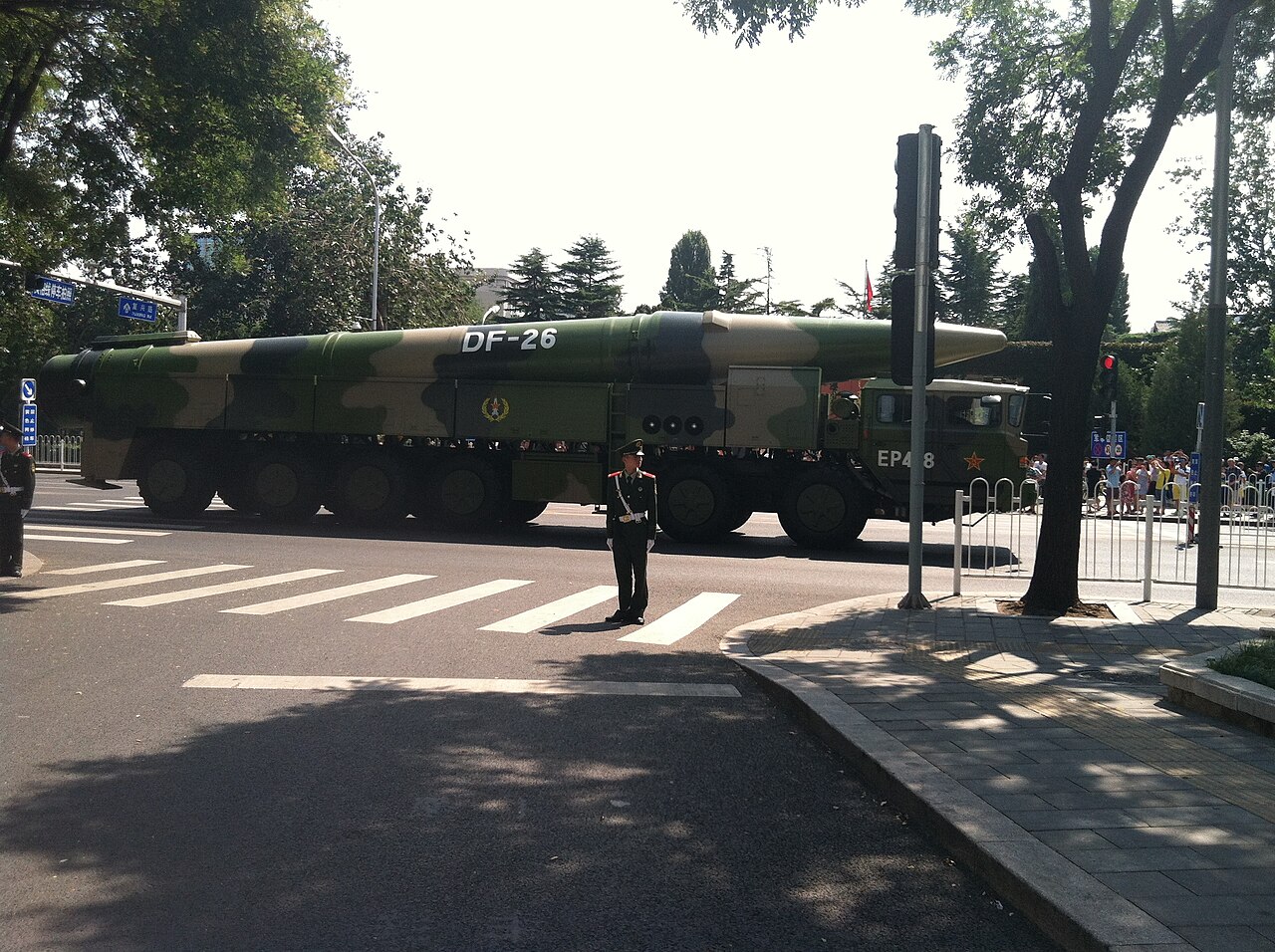
Understanding the DF-26
The Dong Feng-26 (DF-26) is a road-mobile intermediate-range ballistic missile capable of carrying either conventional or nuclear payloads.
Its publicly reported range is approximately 4,000 kilometers, allowing it to engage targets across a wide operational area.
The missile's mobility allows launch vehicles to relocate frequently, making them less vulnerable than fixed launch installations.
⬇
Rapid Deployment
⬇
Long-Range Strike
⬇
Enhanced Operational Flexibility
What Is New About the Upgraded DF-26?
One of the most noticeable external changes is the presence of control fins positioned near the missile's warhead.
Although official confirmation has not been provided, such control surfaces could potentially allow the warhead to make controlled adjustments during the final phase of flight.
Possible advantages may include:
- Greater terminal maneuverability.
- Improved strike accuracy.
- Enhanced ability to engage moving targets.
- Increased difficulty for missile-defense systems attempting interception.
- Improved trajectory correction during descent.
⬇
Terminal Maneuvering
⬇
Improved Precision
⬇
Greater Survivability
What Is Terminal Maneuvering?
Traditional ballistic missiles generally follow predictable trajectories after re-entering the atmosphere.
Terminal maneuvering refers to the ability of the warhead to alter its path during the final moments before impact.
This capability can complicate interception because missile-defense systems must continually update their tracking solutions against a changing flight path.
Understanding the DF-17
The DF-17 is a medium-range ballistic missile equipped with a Hypersonic Glide Vehicle (HGV).
Unlike conventional ballistic missiles that descend along predictable ballistic paths, a hypersonic glide vehicle separates from its booster and glides toward its target at extremely high speeds while performing aerodynamic maneuvers.
Its estimated operational range is approximately 1,800 kilometers.
What Is New About the DF-17?
During the exercise, television footage showed a previously unseen bicone-shaped payload configuration mounted on a transporter similar to existing DF-17 launch vehicles.
The exact purpose of this configuration has not been officially disclosed.
Possible explanations discussed by defense analysts include:
- Improved aerodynamic efficiency.
- Modified hypersonic glide vehicle.
- Enhanced maneuverability.
- Updated guidance systems.
- Improved payload integration.
However, these interpretations remain speculative until officially confirmed.
Road Mobility: A Key Advantage
Both missile systems are mounted on large Transporter-Erector-Launchers (TELs).
Road-mobile launchers offer several operational advantages:
- Rapid deployment.
- Frequent relocation.
- Reduced dependence on fixed launch bases.
- Improved survivability.
- Greater strategic flexibility.
⬇
Flexible Positioning
⬇
Reduced Predictability
⬇
Improved Operational Survival
Focus on Automation and Precision
According to official reporting surrounding the exercise, the missile units emphasized:
- Improved automation.
- Higher operational mobility.
- Greater strike precision.
- Enhanced defense-penetration capability.
- Flexible deployment under changing battlefield conditions.
These characteristics reflect broader global trends toward highly mobile missile forces capable of responding quickly to evolving operational environments.
DF-26 vs DF-17
| Feature | DF-26 | DF-17 |
|---|---|---|
| Missile Type | Intermediate-Range Ballistic Missile | Medium-Range Ballistic Missile with Hypersonic Glide Vehicle |
| Estimated Range | ~4,000 km | ~1,800 km |
| Mobility | Road-Mobile | Road-Mobile |
| Primary Enhancement | Terminal maneuver capability (reported) | Hypersonic glide configuration |
Why Are Modern Missile Systems Becoming More Complex?
Missile-defense technologies have advanced considerably over recent decades.
As interception systems improve, missile designers increasingly incorporate:
- Maneuverable reentry vehicles.
- Hypersonic glide vehicles.
- Advanced guidance systems.
- Electronic countermeasures.
- Road mobility.
- Rapid launch capability.
These developments seek to improve survivability and operational effectiveness in increasingly contested environments.
The Engineering Perspective
Developing advanced ballistic and hypersonic missile systems requires expertise across aerodynamics, propulsion, materials science, guidance and navigation, electronics, thermal protection, and systems engineering. As missile speeds increase, engineers must solve increasingly difficult challenges related to heat generation, structural integrity, precision guidance, and communication under extreme flight conditions.
The Strategic Perspective
Military planners increasingly view information, mobility, and adaptability as essential components of modern missile forces. Road-mobile launchers, advanced guidance systems, and maneuverable payloads are intended to provide greater operational flexibility while reducing dependence on fixed infrastructure. These trends reflect the continuing evolution of missile technology in response to advances in surveillance and missile-defense capabilities.
Conclusion
China's public display of an upgraded DF-26 and a new DF-17 configuration highlights ongoing developments in missile technology focused on mobility, precision, maneuverability, and operational flexibility. While many technical details remain undisclosed, the systems illustrate broader trends toward integrating advanced guidance, hypersonic technologies, and mobile launch platforms into modern missile forces. As missile and missile-defense technologies continue to evolve together, future strategic competition is likely to emphasize adaptability and information-driven warfare as much as traditional measures such as range and payload.



0 Comments