The Flanking Maneuver: The Battlefield Strategy That Wins Wars Without Fighting Head-On
Throughout military history, one tactical principle has consistently shaped the outcome of battles: attacking the enemy where they are weakest. The flanking maneuver embodies this idea by striking the sides or rear of an opposing force instead of confronting it directly from the front.
In its simplest form, flanking means moving troops around the side of an enemy formation and attacking from an unexpected direction. When successful, the enemy is forced to defend multiple directions at once, creating confusion, weakening their defensive structure, and often leading to collapse.

Modern infantry units frequently use flanking tactics during combat operations
Understanding the Concept of Flanking
In traditional battlefield formations, armies typically align their troops facing forward toward the enemy. The sides of this formation are known as the flanks. Because soldiers usually focus their attention and firepower toward the front, the sides and rear are inherently more vulnerable.
A flanking maneuver exploits this vulnerability by attacking these exposed areas. The objective is not merely to surprise the enemy but also to disrupt their formation, cut off their supply lines, and sometimes surround them completely.
Types of Flanking Maneuvers
Military strategists generally identify several variations of the flanking maneuver.
- Single Envelopment – attacking one side of the enemy line while holding them in place from the front.
- Double Envelopment – attacking both sides simultaneously, potentially surrounding the enemy.
- Turning Movement – maneuvering around the enemy to threaten their rear and force them to retreat.
- Hammer and Anvil – one force pins the enemy while another strikes from the flank.
Among these, the double envelopment—often called a pincer movement—is considered one of the most devastating tactics because it can completely encircle an enemy army.
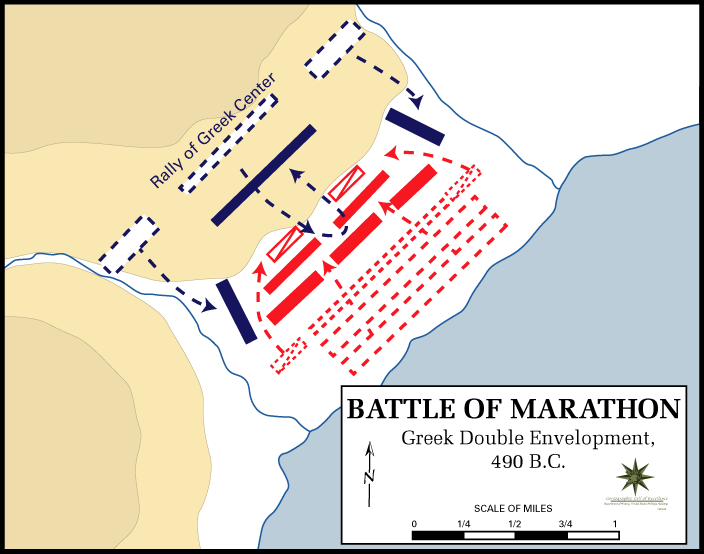
Diagram of the Greek double-envelopment tactic at the Battle of Marathon
Historical Examples of Flanking
Some of the most famous battles in history were decided through flanking maneuvers. In ancient warfare, commanders such as Hannibal, Alexander the Great, and Julius Caesar used flanking attacks to defeat larger armies.
One notable example is the Battle of Cannae (216 BC), where Hannibal’s Carthaginian forces executed a double envelopment that surrounded and destroyed a much larger Roman army. This battle is still studied in modern military academies as a masterpiece of battlefield tactics.
Another classic example occurred during the Battle of Marathon (490 BC), where Greek forces strengthened their wings and attacked the Persian army from both flanks, forcing it into a chaotic retreat.
Flanking in Modern Warfare
Although warfare has evolved dramatically with the introduction of tanks, aircraft, and drones, the core principle of flanking remains unchanged. Modern militaries still attempt to maneuver around enemy defenses rather than assault them directly.
During World War II, mechanized armored divisions frequently executed large-scale flanking operations known as blitzkrieg, rapidly penetrating enemy lines and attacking from the rear. :contentReference[oaicite:4]{index=4}
Similarly, in the 1991 Gulf War, coalition forces used a massive flanking attack known as the “left hook,” bypassing Iraqi defenses and striking from the west to collapse Iraqi positions.
Why Flanking Works
The effectiveness of flanking lies in both psychology and battlefield geometry. When attacked from multiple directions, an army must divide its attention, reducing its ability to coordinate defense.
Flanking also threatens critical elements such as command centers, supply routes, and retreat paths. Once these are compromised, even a well-trained force may lose cohesion and collapse rapidly.
Conclusion
From ancient phalanxes to modern mechanized armies, the flanking maneuver remains one of the most powerful concepts in military strategy. It demonstrates that victory in warfare often depends not on brute strength but on positioning, timing, and strategic imagination.
In the end, the lesson of the flanking maneuver is simple yet profound: sometimes the smartest way to defeat an opponent is not to attack them head-on—but to outmaneuver them entirely.



0 Comments